

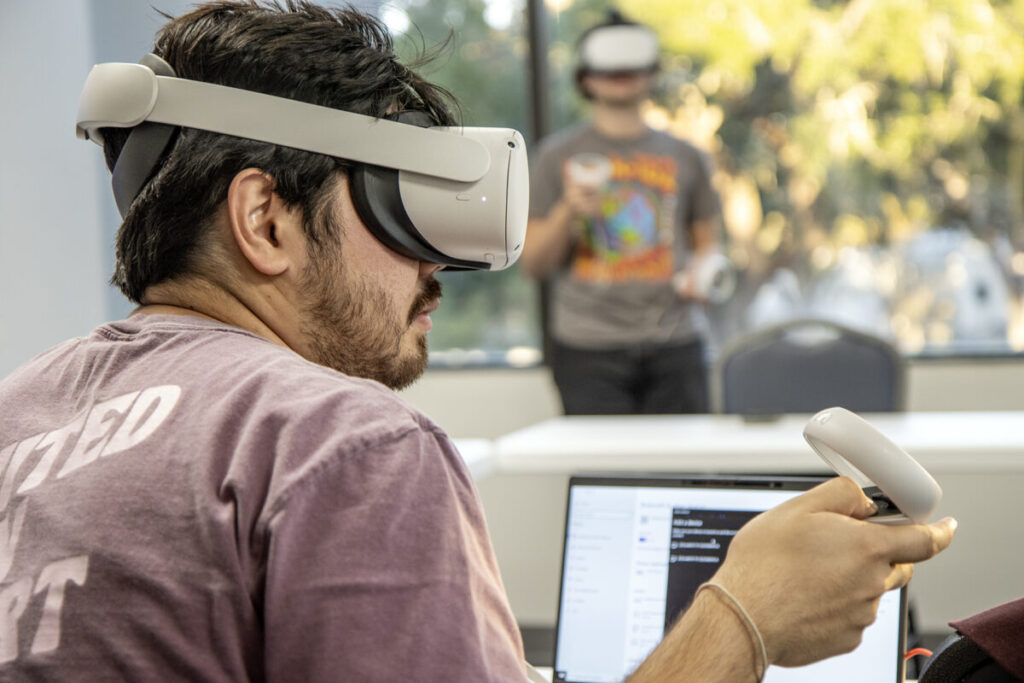
Troy Sirochman sets up his virtual reality headset. The Floridian has participated in three virtual mission trips. He said he realized on the first VR mission trip there’s an entire subset of people who live in the virtual reality world and need to hear the gospel. He’s willing to go where they are to share about Jesus. (IMB Photo)
By Sue Sprenkle, IMB
Editor’s note: This is the first in a two-part series on gospel access made possible through virtual reality.
A piece of toast. Kermit. A purple anime ninja.
Avatar skins flashed across the screen like a late-night meme scroll, each one more absurd than the last. Choosing a character to represent you in the virtual world is hard enough — choosing one that helps start a gospel conversation on a virtual reality mission trip? That’s a whole new level.
Giggles rippled through the short-term mission team when someone clicked on a giant fish perched atop a man in a three-piece suit. Ridiculous? Yes. But also a ready-made segue into Jesus feeding the 5,000 or why a fish is a universal symbol of Christianity.
Matthew Banther lifted his VR headset and blinked at the room around him inside Calvary Church in Clearwater, Florida. This didn’t look like an average mission trip training. It looked like a group of friends hanging out, lost in their own digital universes.
Young adults sat staring into the middle distance while reaching out to tap at things no one else could see. At the front, a projector lit up the International Mission Board’s futuristic Hope Café floating on an asteroid. The team’s avatars milled around like regulars, ready to talk to people from other countries about the gospel without physically leaving Florida.
Virtual reality mission trips might look a little different, but the purpose is the same: take the gospel to those who haven’t heard, no matter where they are.
“This isn’t a video game. Behind every avatar is a real person that we interact with in real time,” Banther explained, sliding the headset back down to continue the training. “Get ready for a pioneering new way to reach the lost with the gospel.”
VIRTUAL REALITY AND MISSIONS
For the last 18 months, Calvary Church has partnered with the IMB’s Japan digital engagement team to build a strategy for sharing the gospel in virtual spaces that don’t physically exist yet attract 171 million visitors every day. With 60% of Japan’s population predicted to use some form of virtual reality daily by 2030, Daniel Rice knew his IMB team needed to reach communities that exist behind passwords and rendered 4K.
The IMB missionary living in Japan donned a VR headset and saw doors open to people they rarely met in person like the Hikikomori. In Japan, they are known as individuals who withdraw from society and spend countless hours in virtual worlds. As Rice’s team explored, they also encountered busy professionals whose only free time was spent online.
“Most Japanese adults are consumed with work,” Rice said, noting the difficulty missionaries often have in establishing relationships. “Yet, when they get home, many will put on VR headsets to watch television, play games or socialize with friends. Now, through VR, we are interacting with them.”
A biannual virtual reality convention called Virtual Market, but most commonly known as Vket, became the perfect place to meet people. Like any real-world expo, it features eye-catching booths, marketplaces and spaces designed for hanging out. It was an ideal testing ground for this new VR ministry. Rice just needed more hands.
So, when Calvary Church asked what the biggest need was, Rice answered simply, “You.”
He envisioned a mission team via virtual reality working alongside him. Time zones worked in their favor. Volunteers in Florida could log in early in the morning, right as Japanese users finished work and entered Vket.
Banther, Calvary’s communication director, was skeptical at first. How could avatars and gamer tags matter in missions? But one visit changed everything.
Inside a virtual room packed with more than 100 people, Banther saw the truth: every avatar represented a real person with real struggles and spiritual needs.
“In that space, I shared the gospel,” he said. “I realized we can reach the nations through virtual reality. There’s no excuse. It went from being foreign to something tangible that had to be done.”
VR MISSION TRIP
Twenty people signed up for the first VR mission trip. The church borrowed headsets from a local school. And while a few volunteers already knew the tech, most stepped into the virtual world for the first time.
They quickly adjusted to the strange sensation of being both in a church room and standing inside a digital world at the same time. Movements felt natural; conversations felt surprisingly personal. People behind the avatars felt close, even if they were thousands of miles away. The more people they met, the more Calvary Church understood why this virtual space mattered so much for ministry.
Calvary has now completed three trips, with a fourth coming in July. Jill Kane has joined every one. The self-described nerd loved the fact that she didn’t have to take time off work.
“I stayed in Florida the entire two weeks,” she said. “I logged in early…served in VR as the Japanese ended their day, then I went to work. With one piece of equipment, we can engage and reach people all around the world.”
The church and IMB treated the mission trip like any other: pre-trip training, virtual safety guidelines and practical ways to shift conversations toward the gospel. Hint: Using an avatar is a good starting point.
These characters are often how people express themselves; and most openly talk about what their avatar means. Banther uses a skeleton dressed as a lifeguard to represent Ephesians 2:4-6. He shares that he was once dead but brought back to life with Christ; now it’s his job, as a lifeguard, to bring others to Jesus.
EVANGELISM
Rice and Banther quickly realized VR opened doors that traditional methods, like street evangelism or five-minute English, struggled to unlock in Japan. In VR, people weren’t rushing to catch trains. They were at home, relaxed and wanted to talk. And in a culture of conformity, the anonymity of an avatar gave them room to question long-held beliefs.
Troy Sirochman saw this firsthand when he struck up a conversation with a few guys in the Vket lobby. Since it was December, the Calvary volunteer asked what they knew about Christmas. As he shared the story from the Bible, more people drifted over to listen and ask questions.
“One guy modified his headset to auto-translate my English [into his language]. Then, he translated for his friends,” Sirochman said. “It was the most unique thing I’ve ever experienced.”
During the first trip, volunteers had more than 130 gospel conversations and delivered 30 full gospel presentations. They not only reached Japanese, but Malaysians, Swedes, Americans and many others. VR made it possible to engage communities normally closed to the gospel.
“The more we tested, the more we realized we can build a place for ministry right now, so when the rest of the world adopts this into their regular lives, the church will be there and ready to serve them with the gospel,” Rice said.
NEXT STEPS
This vision became clearer with each mission trip to Vket, when simple conversations in virtual lobbies turned into real connections. People came to the convention with the purpose of connecting, so when Sirochman invited the guys he’d met to a party inside the IMB’s own virtual world, they readily followed.
Hope Café, a world within Vket and built by the IMB digital engagement team, is designed as a hub for ministry. Scripture and gospel materials pop up in Japanese with a single tap on the wall. Every party at the Hope Café features a full gospel presentation.
One advantage of this type of mission trip is that volunteers don’t just drop into these virtual worlds and then disappear after the event.
“We’re trying to form relationships that last,” Sirochman instructed new short-term missionaries during training. He’s active on the social platform Discord with about 70 people, most of whom he met at past Vket events. Through that space, he continues sharing the good news of Jesus and answering questions. Banther has spent almost a year teaching Biblical truths to a Japanese young adult through instant messaging.
These relationships aren’t meant to stay online forever. Rice and Banther are building the next phase: bringing connections into real life or IRL. Their vision is to connect people with missionaries or local believers in their country so they can grow, get plugged into a church and be discipled.
The first step is a hybrid mission trip this July. The team will attend Vket as usual, but a few members will travel to Tokyo for Vket-Real. Tens of thousands will gather in person to meet friends they first encountered in virtual worlds. IMB missionaries and Calvary Church will be there together, inviting their online friends to coffee for face-to-face conversations about Jesus.
“This is not a trend. It’s a new way of communicating and gathering. It’s where we, as believers, should be,” Banther said as he wrapped the night’s training and vision casting. “I’m always amazed and thankful that in this new era of communication, a nerd like me can reach the nations through virtual reality.”
Adalynn Fowler contributed to this story.