
Over the past decade, public confidence in colleges and universities has declined sharply.
Parents wonder whether the values they’ve instilled at home will survive four years on campus, and whether the job prospects are worth the investment. Pastors hear stories about institutions that have moved away from their founding convictions. Legislators question whether universities are good stewards of the public trust. Faculty and staff at many institutions feel caught between growing cultural pressures and the work they were called to do.
This erosion of trust shows up in conversations I have regularly. I take it seriously. Not because I believe it accurately describes Ouachita today, but because I believe Ouachita has a responsibility to answer the question clearly rather than assume the answer is obvious.
Ouachita remains a Christ-centered, Baptist university, rooted in the authority of Scripture and intent on preparing students for life, not just a job (though we care about that too). And we are deeply committed to our historic partnership with Arkansas Baptists. What follows is a reminder of who we are and an explanation of what we are doing to make sure Ouachita remains true for the next generation.
The People Who Make Ouachita
When I think about what makes Ouachita distinctive, I don’t start with programs or facilities. I start with people.
In his book The Fabric of Faithfulness, Steven Garber studied what it takes for college students to develop lasting faith during their university years and to keep it. He identified three essentials: a biblical worldview, mentors who embody those beliefs and a community of people who share them.
That framework captures something I’ve observed at Ouachita during my 10 years here. It describes why our faculty and staff feel called to serve here.
I think of a finance professor who opens his home each week to lead a Bible study for students. I think of nursing faculty who take students on mission trips and teach them to see healthcare as an extension of the gospel. I think of residence life staff who carry on conversations long after 5 p.m., sitting with a student who is wrestling with hard questions and refusing to let those questions go unanswered.
These are the kinds of people Garber describes as role models who exemplify what faithfulness looks like in practice. These moments are common across departments at Ouachita, and they reflect something deep in our fabric: faculty and staff who believe investing in students is their calling, not an institutional slogan.
How Our Board of Trustees is Leading
Against the backdrop of declining trust in higher education and because of the significance of our calling to invest in students, Ouachita’s Board of Trustees has taken two unanimous actions to ensure our institutional commitments are clear and enduring.
First, at its March 12 meeting, the Board unanimously adopted a Board of Trustees Covenant, a serious, theologically grounded commitment. The word “covenant” was chosen carefully. This was not a symbolic gesture or a public relations statement. It was the trustees putting in writing that they hold themselves accountable to the faith commitments they steward on behalf of the institution.
The Board of Trustees Covenant states:
As a trustee of Ouachita Baptist University, my signature affirms my belief in and support of the university’s Vision, Mission, Values, and Statement of Faith, and reflects my agreement to uphold and not act in ways that undermine the university’s Statement on Sexuality, Gender, and Marriage.
I affirm the university’s historic and enduring relationship with the Arkansas Baptist State Convention, which established Ouachita in 1886. I acknowledge the Baptist Faith & Message 2000 as the university’s doctrinal guide and support Ouachita’s commitment to live out its principles in both spirit and practice. I further recognize that trustees are called to be “sensitive to the expression of the Convention’s will in all matters.”
In signing this Covenant, I accept these responsibilities as a condition of my service and commit to stewarding Ouachita Baptist University with integrity and fidelity.
The Covenant’s first paragraph anchors trustees to key statements on the mission of our university, including a clear and concise Statement of Faith and a Statement on Sexuality, Gender, and Marriage that was developed in 2024 to update Ouachita’s language in our cultural moment. This statement articulates with pastoral clarity what Ouachita and Arkansas Baptists have always believed.
The Covenant’s next paragraph honors the relationship between Arkansas Baptists and our university that has endured for 140 years. From Ouachita’s founding through more than a century of generous support, we’ve partnered to prepare over six generations of students for life. We’ve sent alumni to serve in churches, on the mission field and as business leaders; we’ve watched their children and grandchildren returning for Super Summer, PraiseWorks and even sometimes to move into the same freshman hall their parents lived in. Greater than mere nostalgia, this is a record of God’s faithfulness, animating our commitment for this partnership to go from “strength to strength” together (Psalm 84:7).
Second, the Board also directed me to receive input from the campus community and develop a separate statement of affirmation for faculty and staff, with a proposal to be considered at the June board meeting.
The relationship between these two actions matters. The trustees began with themselves. Before asking anything of faculty and staff, they put their own commitments in writing and made them a condition of their own service. The faculty and staff affirmation will be a separate document, developed with input from shared governance groups and the broader campus community.
Why a Statement of Affirmation Matters
If our community is already engaging in faithful work, why formalize a statement of affirmation? Because clarity serves everyone.
Universities that once held firm convictions have moved away from them, sometimes gradually and sometimes quickly. The cultural pressures are real, and no campus is entirely immune. There was an era when the statements mentioned above could be assumed, but times have changed. A statement of affirmation ensures that the institution’s commitments are visible and shared, not dependent on the convictions of any one person or generation.
To return to Garber’s framework: Ouachita is rich in faithful mentors and community. Our faculty and staff are dedicated, and the bonds students form here last a lifetime. But Garber’s research is clear that those two elements alone are not enough. Without shared convictions, articulated and affirmed and held in common, even the best mentoring and the deepest community can slowly lose their moorings. A statement of affirmation strengthens the foundation on which everything else rests.
What I’m Asking of Arkansas Baptists
If you are a pastor, a parent or a church leader who cares about Ouachita, I want to ask three things of you.
First, pray for our campus regularly. The daily work of rigorous teaching, personal mentoring and faithful Christian witness in an academic environment carries a weight that is easy to underestimate. Our faculty and staff need your prayers and your encouragement.
Second, trust our Trustees. They are doing this carefully, collaboratively and with deep respect for the people who make Ouachita what it is. As Board Chair Clay Conly ’98, a member of First Baptist Church Rogers, shared with our faculty and staff in March, “All decisions we make are prayerfully considered and discussed. Ouachita is not charting a new path; we are reaffirming our commitment to the path we’ve been on for over a century.”
Third, keep sending students to schools like Ouachita and Williams. I am grateful for your partnership and for your trust.
Our prayer is that these steps by the Board will help the Ouachita campus community remain faithful, effective and a place where transformative education prepares students to love God and engage in lives of meaningful work.
We take these steps because we believe Ouachita’s identity, calling and accountability as an unwaveringly Christ-centered, Baptist university is worth protecting, worth clarifying and worth handing on faithfully to the next generation.
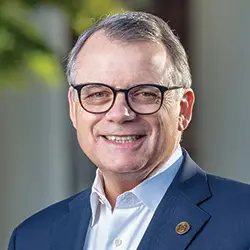
Dr. Ben Sells is the 16th president of Ouachita Baptist University in Arkadelphia, Arkansas.