

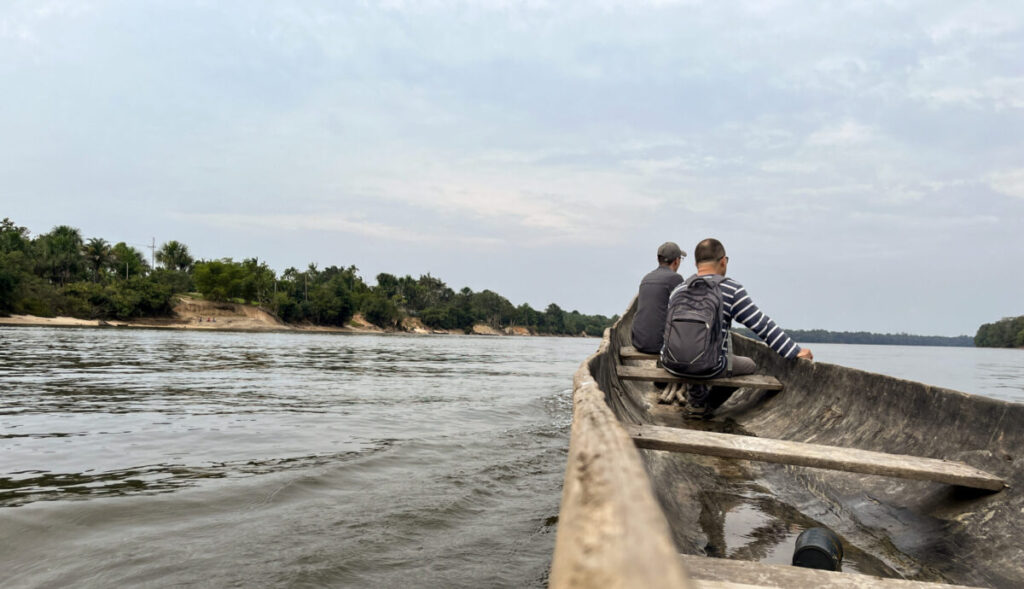
The IMB’s Project 3000 initiative focuses on finding and researching the remaining unengaged and unreached people groups with the gospel. (IMB Photo)
By Sue Sprenkle, IMB
It took weeks of research, both online and in person, to come up with a guess on where the Sys people lived in South Asia. Even then, the information contradicted itself. One finding listed 300 people among the group while another had 230,000. There was not even a digital footprint for International Mission Board missionary John Pratt to follow in his search for this unengaged, unreached people group.
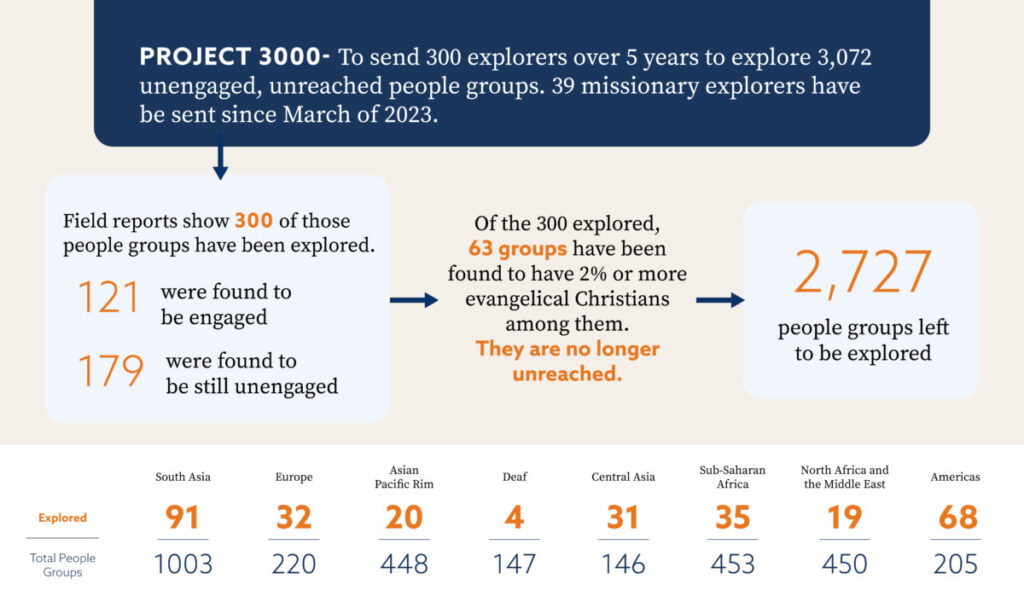
Despite being on a list of 3,072 unengaged people groups in the world, Pratt wondered if the Sys still existed, let alone if they’d ever heard the gospel. It’s his job, along with 39 other missionary explorers, to find and research these people groups as part of the IMB’s Project 3000 initiative. Many of these groups are considered unengaged with the gospel for a reason — remote locations, other religious beliefs or, as in the case of the Sys, lack of information.
In the last three years, teams made up of IMB missionaries or missionary explorers, translators and local believers have found 337 of these people groups and engaged 121 with the gospel for the very first time.
Wait. That math doesn’t math. If an unengaged group is located, doesn’t that mean it is now engaged and taken off the UUPG list? No.
According to Kelly Zbinden, IMB’s Project 3000 global coordinator, this just means the people groups have been “explored” — pockets of the group located with cultural aspects, language, literature and religious beliefs curated. He offered these definitions to help explain:
Unengaged: Lacks Christian presence. No known active strategy for sharing the gospel among the people group.
Unreached: Less than 2% of the people group identify as evangelical Christian. Lack sufficient indigenous believers to evangelize their own people without outside assistance.
“It’s also not considered ‘engaged’ if a team – missionary or church volunteers – meets an unengaged people group, shares the gospel and then leaves after a day or two,” Zbinden explained. “For a people group to be considered engaged, there needs to be a sustained gospel focus and presence.”
Researchers from IMB and other like-minded organizations make the ultimate decision to take a people group off the list. They use mounds of data and technology to support their findings. But for the sake of simplicity, taking a people group off the unengaged list normally happens in one of three ways:
1. No longer exists
When Pratt couldn’t find current information about the Sys people, he was ready to cross them off the UUPG list and move on. His research supervisors, though, needed feet on the ground to prove it.
So, the missionary explorer flew to the estimated location, drove eight more hours and worked with local pastors in the search. One pastor thought he might know someone who could help and invited Pratt to his home.
“I walked through the door and met a crowd of smiling faces,” Pratt said. “These were my contact’s Sys neighbors. We found them!”
Making sure all people have a chance to hear the gospel is why a people group is not crossed off the list until it can be proven they do not exist. IMB missionary Rees Morgan, who explored 12 UUPGs in the western part of Africa, explained what is often referred to as “not existing” occurs when a smaller people group assimilates with a larger one.
He offered another definition to help with this concept:
People Group: A group of individuals who share a common self-identity. This might include ethnicity, language, culture, religion and social structure. The IMB further defines it as the largest group through which the gospel can flow without encountering significant barriers of understanding and acceptance.
Morgan encountered a people group whose nomadic lifestyle had them crossing back and forth between Sierra Leone and Liberia. As time passed, they settled in Sierra Leone and blended into the larger Mende culture. While the missionary explorer found members of this Vai people group, only two older people could recall their original language. They intermarried and adopted the language, customs and religious beliefs of the majority people group surrounding them.
“This people group didn’t consider themselves Vai anymore. No one around them considered them as part of that people group in Sierra Leone,” Morgan said. “So, they were taken off the UUPG list as the Vai of Sierra Leone and are now part of the long-term ministry strategy for the other people group.”
2. PTL! Already has Christian presence
When Pratt sat down to interview some Sys people, he was in for a big surprise. Those who came to meet with him were all evangelical believers, including several pastors.
“We found hundreds of believers and around 15 pastors,” Pratt noted. “Some of these believers walked almost seven miles and swam across a river too deep to touch bottom while holding dry clothes over their heads just to attend church on Sunday.”
The Sys lived in such a remote location that none of this was known or documented. For three weeks, the explorer team learned all they could about this people group’s customs and how God had been working among them for decades.
3. Ministry strategy developed with sustained presence
For most people groups on the UUPG list, the normal way to be scratched off is when a ministry strategy is developed specific to them and someone — a church (local or global) or missions organization — puts that plan into action.
June Estes has explored around 18 UUPGs in South Asia and helped missionaries and global churches create plans to engage these people groups. She sat in homes, drinking endless cups of chai, in an effort to learn as much as she could about each people group. These reports are used in creating a ministry plan, so Estes asked similar questions to everyone. When they talked about religious beliefs, however, it was only natural for the missionary explorer to share her own.
Sometimes her team was the first to share the gospel with an unengaged people group. Knowing she would only be in the area for a few weeks, Estes said it was important to work alongside local Christians, pastors and churches, whenever this was possible, so there could be follow up.
In fact, missionary explorers spend as much time training existing believers in evangelism and healthy church multiplication as they do researching. Pratt’s team spent many late nights sitting on the floor of Sys homes reading the Bible, teaching God’s commands and singing worship songs. The explorer team discipled and encouraged the Sys to share the good news beyond their own villages.
“Our hope is that there will be local ownership of the Great Commission for every people and place,” Estes said. “It is such a privilege working alongside local pastors sharing the gospel and see the Lord burden their hearts for reaching those who have not yet believed.”
So far, 121 people groups are now considered “engaged.”
That statistic calls for a double celebration! Not only is there a sustaining effort for reaching them with the gospel, but also an individual or group answered God’s call to the nations.
More than a list
There are roughly 2,700 unengaged, unreached people groups left to be explored. For Pratt, these are more than just names on a list. They are future brothers and sisters in Christ.
“When we go and look for UUPGs and take the gospel to them…God will not waste it,” the missionary explorer said with conviction, even though he witnessed many say “no” to Jesus in the last two years.
For confirmation, all Pratt has to do is listen to the people he once thought didn’t exist, recounting their church history:
Almost 100 years ago, some Christians felt convicted the Sys didn’t have the gospel. These Christians faced hardships and sickness to get the good news to this remote part of the world.
Even though many said, “no,” some chose to follow Jesus. The seeds of the gospel were planted. Long after the first Christian presence left and their own country dropped them from the official census because they were too remote, God continued to work and multiply.
“What will someone report 100 years from now about an unengaged, unreached people group we visited?” Pratt reflected.
Pray for these people groups where there are no known believers. Ask for the seeds of the gospel to take root. Pray for local and global churches to heed God’s call for a sustained gospel focus and presence among unengaged, unreached people groups.
Some names and people group names changed for security
Call to action:
1. Join the project 3000 team. See if you qualify. There is now no age limit. Seek out the unengaged. Link: https://www.imb.org/missionary-explorer/
2. Give today. Your generous financial gifts to the Lottie Moon Christmas Offering and Cooperative Program support the ministry of IMB missionaries.