

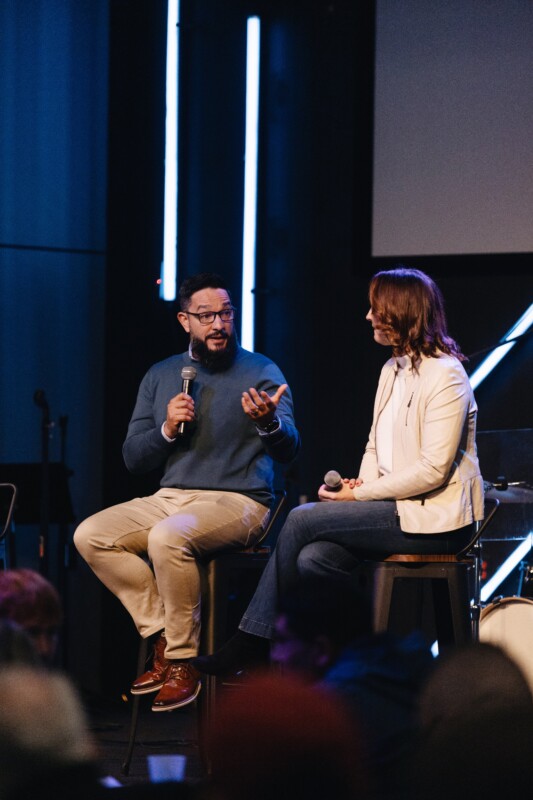
Neftali Alverio Jr., vice president of Technology and Digital Innovation at Lifeway, speaks next to Dr. Katie Fruge, director of the Center for Cultural Engagement and The Christian Life Commission for the Baptist General Convention of Texas, during a Q-and-A at the ABSC AI Conference held at Second Baptist Church in Conway. (Cassidy Higgins/ABSC)
CONWAY, Ark. – Arkansas Baptists gathered at Second Baptist Church in Conway on Monday, Dec. 15, to learn more about artificial intelligence (AI).
The AI Conference, hosted by the Arkansas Baptist State Convention (ABSC), had four sessions that focused on the history of AI and uses of it today, ethical use of AI, practical uses of AI in the church, and relational/sociological concerns.
Speakers for the conference were Dr. Katie Fruge, director of the Center for Cultural Engagement and The Christian Life Commission for the Baptist General Convention of Texas, and Neftali Alverio Jr., vice president of Technology and Digital Innovation at Lifeway.
For his first session, Alverio said his goal was to provide a foundation on AI for pastors and ministry leaders that are looking to understand advancement in artificial intelligence, “so they are empowered to engage the culture and shepherd their congregations well.”
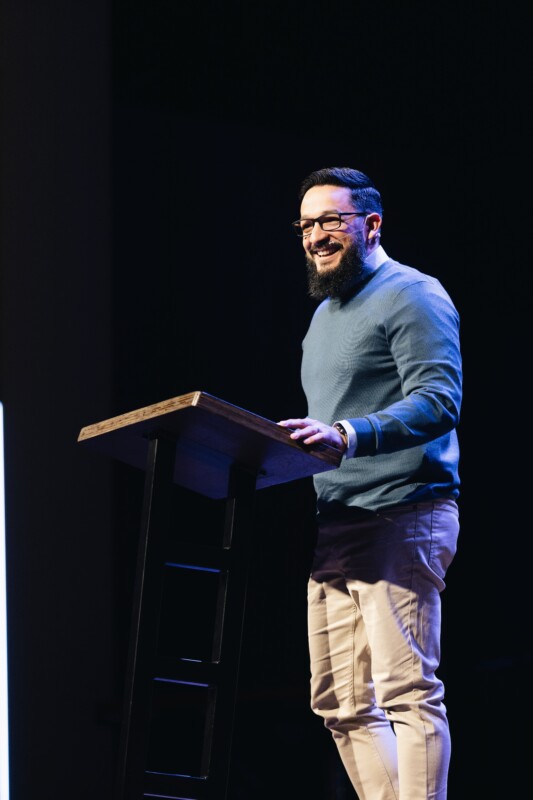
“We need to be aware and prayerfully engaging in what this is and understanding it, so that we understand how to guide our congregations and how to help them think through these things through a biblical lens,” he said.
He defined AI as the “use of computer systems to simulate the ability to acquire and apply knowledge and skills by observing data, identifying patterns, making predictions, and generating helpful applications.” It’s a broad field of computer science dedicated to creating computer systems that can perform tasks that typically require human intelligence. He also touched on various types of AI, including generative AI, machine learning, and deep learning.
Additionally, he shared about future advancements that are highly likely and three things he said they know for certain, which are:
- Technology will continue to advance rapidly and have an increased impact on our lives.
- Our churches will continue to need help navigating these and future advancements.
- God is sovereign and His church should never fear the future.
In his second session of the day, Alverio focused on equipping pastors and ministry leaders with a biblical lens for wisely discerning and stewarding emerging technologies so they can guide with clarity and conviction. He shared two truths about God’s relationship to technology. Technology has a source. “Everything, including tech, is providentially given by God,” he said. Additionally, technology has a purpose. “Everything, including tech, is given by God for His glory.”
Although technology is sometimes used sinfully, Alverio said even the most evil use is still under God’s sovereignty. He referenced Isaiah 54:16-17, “Look, I have created the craftsman who blows on the charcoal fire and produces a weapon suitable for its task; and I have created the destroyer to cause havoc. No weapon formed against you will succeed, and you will refute any accusation raised against you in court. This is the heritage of the Lord’s servants, and their vindication is from me. This is the Lord’s declaration.”
“No technological advancement formed against God or His people will ultimately thwart God’s plan or His people,” Alverio said. “Because God creates the innovators, the entrepreneurs, the engineers, and those who would wield it for havoc or for Kingdom building.”
Alverio encouraged those in attendance to embrace a vision of fruitful work, to be ambassadors of biblical truth, and to treasure the image of God, not just in themselves but in others.
Furthermore, Alverio shared four areas where AI can help advance ministry work: preparation, content creation, media, and communication.
His final advice to ministry leaders was to engage prayerfully, discern biblically, and shepherd confidently.
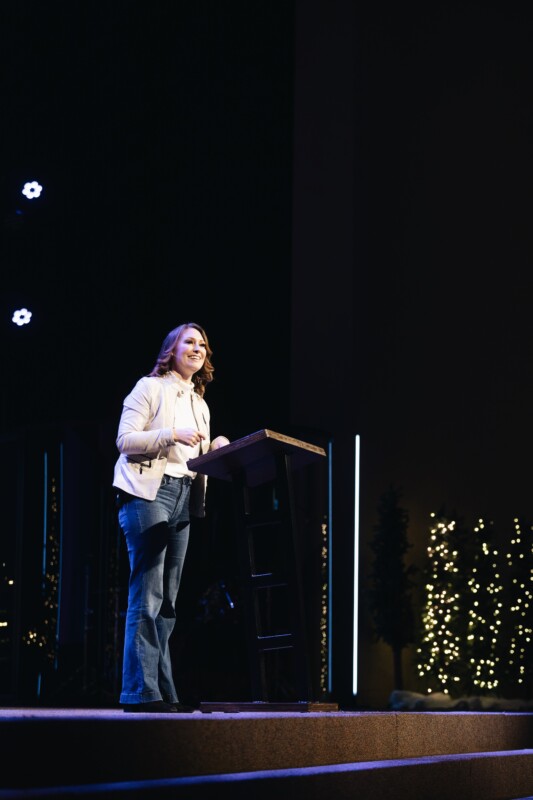
In her first session, Fruge shared a few best practices for ministry leaders when it comes to AI, such as utilizing AI in a way that is supportive of good Kingdom-building work, but never as a replacement and as a resource not research. Fruge encouraged ministry leaders to establish clear boundaries and expectations around the use of AI in their ministry and to identify the benefits of these tools as Kingdom-building opportunities.
In her second and final session of the day, Fruge talked about generational distinctions and how technology plays a key role in connecting, uniting, and dividing individuals. She touched on ontological foundations, AI in Christian relationships, theology of community, discipleship in a digital moment, and faith community in a digital age.
“We, the church, are united because we are His image bearers. It is our shared mission and destiny as image bearers of Christ to step boldly into the digital age, audaciously committed to embodying Christ and His love for each other and Himself,” she said.
Following the conference, ABSC Next Gen and Discipleship Strategist Bill Newton said he appreciated that Alverio and Fruge “emphasized the way that we are created in God’s image” and how the AI Chat bot phenomenon cannot replace that.
Faulkner Baptist Association Associational Missions Strategist (AMS) Scott Miller touted the conference, saying it answered the questions a lot of their guys have been asking about AI.
“One thing that I really appreciated was they didn’t come in and try to scare us or treat AI as the boogeyman but to acknowledge that it exists. It’s there, so how can we as churches and pastors minister to the culture that is around us,” he said, adding Alverio and Fruge stressed the value of relationships. “I think we forget that a lot of times as believers, as disciples, no matter how smart one might be or how much information one might have, it is still the relationships that we have that really make the difference.”
Sessions of the AI conference will be available on the ABSC website soon.