
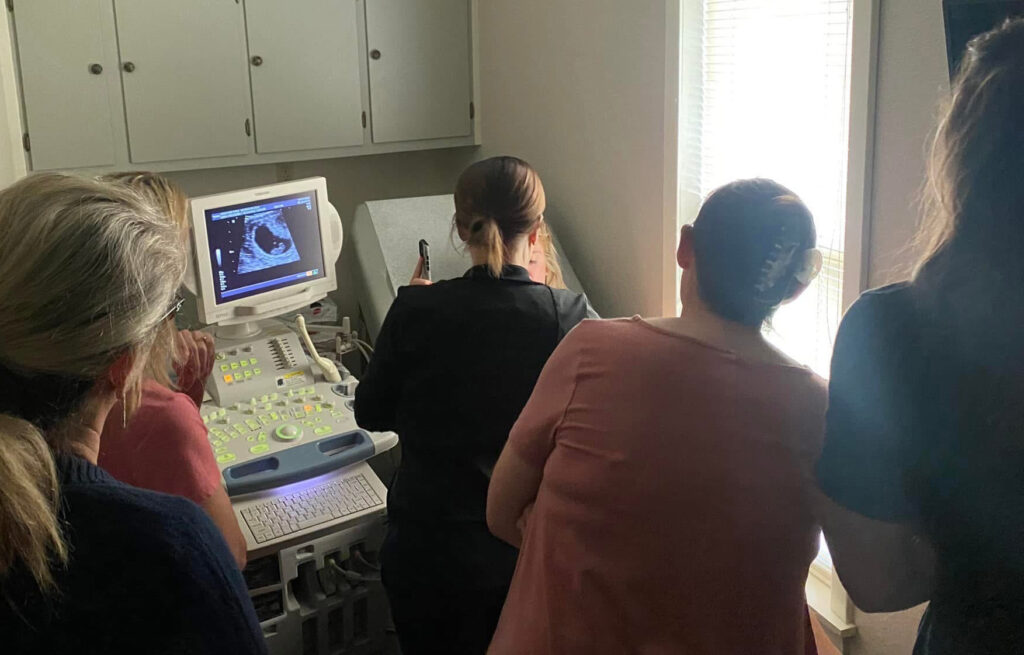
The staff of a pregnancy center in Nashville, Ark., surrounds a woman receiving an ultrasound exam. The center is a ministry of the Little River Baptist Association and has saved at least 11 babies since its launch in 2023. (Submitted photo)
By David Roach
NEWPORT NEWS, Va. (BP) – Shortly after immigrating to Virginia, a Jamaican woman discovered she and her husband were expecting a baby. Only he was still in Jamaica, and she was scared. Abortion became a consideration.
That’s when she connected with Care Net Peninsula, a pro-life pregnancy support center in Newport News, Va. Through the center, she renewed her commitment to Christ, chose life and connected with a godly mentor in a local church. That changed everything.
The church bought her a car to get to work and helped her care for the new baby. The woman’s family got plugged into the church and began serving Christ faithfully. That’s how Care Net Peninsula executive director Ryan Holloway hopes all client stories end.
“The best solution for a woman without a husband who chooses life and raises the baby is not a pregnancy center,” Holloway said. The “next best thing in God’s design to a godly husband is a godly church.”
Churches are called not merely to fund pregnancy support centers, say Holloway and other pregnancy center leaders. Church involvement is vital to what centers were founded to accomplish.
America has approximately 3,000 pregnancy support centers in all 50 states. The centers are local, nonprofit organizations that provide support and information to women and men facing decisions about unplanned pregnancies. Many also share the message of Jesus. The number of new clients served by those centers eclipsed 1 million for the first time in 2024, according to the Lozier Institute, a pro-life research organization.
Pregnancy centers began to emerge in the late 1960s, according to a report by the SBC’s Ethics & Religious Liberty Commission. Initially, centers tended to have strong church ties, said Thomas Glessner, president of the National Institute of Family and Life Advocates (NIFLA), an organization that resources pro-life pregnancy centers. But over time, some centers wanted to avoid being seen as “overtly religious” for fear of alienating abortion-minded women.
That was a mistake, Glessner said, adding that churches are needed to help maintain the pregnancy center movement’s dual focus of saving babies’ physical lives and sharing the Gospel.
“Our roots are in the church,” Glessner said. NIFLA tells centers, “Your religious roots give you added legal protection, and you don’t run away from it because the First Amendment protects you.”
Thankfully, Glessner said, many pregnancy centers are rediscovering their church roots. That provides an open door for congregations to play a larger role in the ministries of their local centers.
Holloway says it’s up to both churches and centers to actualize that possibility. More than 100 churches have given money to Care Net Peninsula in the past year, yet the relationship with churches transcends financial support. Holloway holds a quarterly lunch for local pastors where they eat and “talk shop” about the center and its challenges. He also has individual lunches with pastors and recruits church volunteers for ministry opportunities like spiritual mentorship.
Relationships between churches and pregnancy centers aren’t entirely up to the centers though. Holloway counsels pro-life churches to be proactive about connecting with a local pregnancy center.
“The pastor should call that pregnancy center,” Holloway said, “meet with their executive director and say, ‘We see this as critical to our outreach in the local community, and we want to bring anything we can to the table. What does that mean?’”
Among proactively pro-life churches are the 35 congregations that cooperate with the Little River Baptist Association in rural southwest Arkansas. As associational mission strategist, Robby Sherman worked to revitalize the association beginning in 2019, pastors cited the need to help mothers with unplanned pregnancies. That led the association to remodel its office as a pregnancy center, which opened in 2023.
The Nashville, Ark., pregnancy center is a ministry of the association, with the association’s executive board serving as the pregnancy center’s board. The center is the second largest item in the associational budget following personnel. It offers a variety of counseling, mentoring and medical services, including ultrasounds thanks to the donation of a new ultrasound machine last year by PreBorn!, a Christian group that donates ultrasound machines to help share the Gospel.
To date, 62 clients have been served, with 11 babies born since the center’s inception.
“We’re an underserved area,” Sherman said of prenatal medical care. “There’s nobody doing what we’re doing here. Even our hospital doesn’t have an OB-GYN … Goal No. 1 is to share the Gospel. Goal No. 2 is to help them choose life instead of abortion.”
Pregnancy centers like the Little River Association’s can fill an important gap in rural medicine. More than 2.3 million women of childbearing age in the U.S. live in a county without any OB-GYN, birthing center or hospital that delivers babies, NPR reported. Over the past few years, more than 100 hospitals have closed their maternity units.
For southwest Arkansas churches, that reality provided an open door. “Our churches here are very pro-life, but they wanted to be deeper than just vocal,” Sherman said.
The center’s impact has been both immediate and eternal. When a mother recently chose life, Sherman reflected that he will be 78 when the baby reaches adulthood. By the time the child can impact the world for Christ as an adult, Sherman likely will be in heaven.
“We won’t know until we get to heaven what God does with this,” he said. “I look forward to seeing the impact that we have.”
David Roach is a writer in Mobile, Ala.