

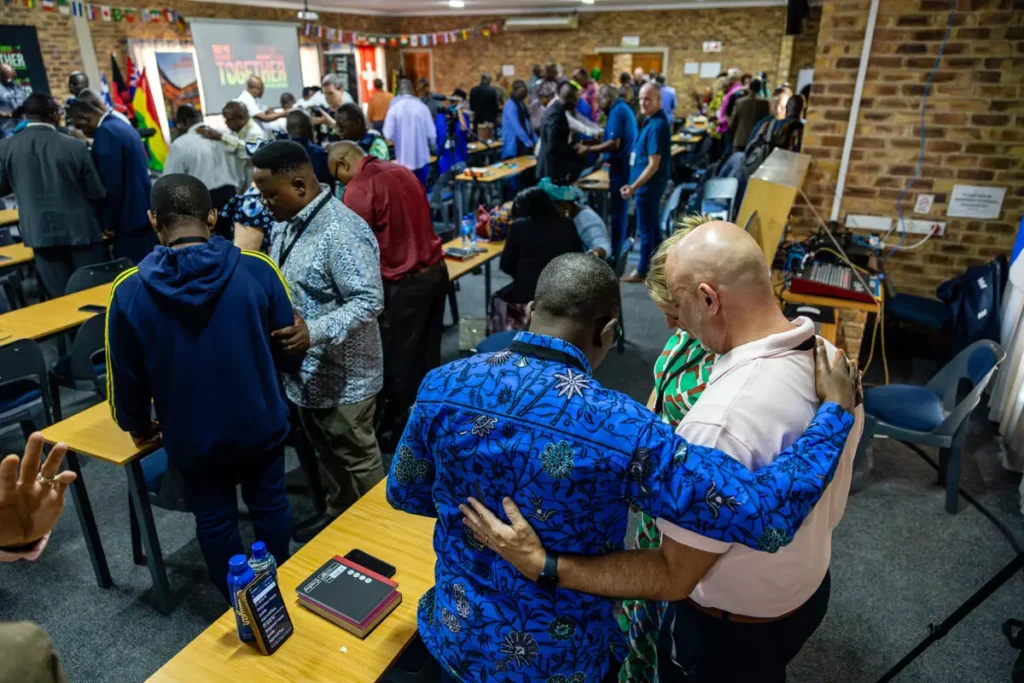
Attendees pray together during the Together: Africa to the Nations conference in Johannesburg, South Africa. One hundred missions-minded African leaders from 33 nations attended the conference along with IMB missionaries and staff. (IMB Photo)
By Melanie Clinton, IMB
One hundred African leaders from 33 nations assembled in Johannesburg, South Africa, in early February to discuss the future of missions on their continent. A common theme reverberated from their lips: It’s time for Africa to embrace its potential as the world’s next great missionary sending force.
“God is doing some things in Africa,” said Ezekiel Ajibade, a conference keynote speaker and rector of the Baptist College of Theology in Lagos, Nigeria. “God has resourced us. He has equipped us. We have the energy, we have the resilience, we have the training. We have a lot that God has invested in us as Africans, and I think now is the time for us to do this work.”
The mission-minded leaders gathered at the Together: Africa to the Nations conference with the goal of bolstering collaboration in their missionary sending efforts. Although the conference was hosted by the International Mission Board, African leaders headlined most keynote addresses and led the workshop discussions.
“The conference was really committed to having African speakers to speak on this African issue, to mobilize the African church,” emphasized Faly Ravoahangy, a pastor and missions leader from Madagascar. He knows that for the gospel to flow both within and from the continent, Africans must take ownership of the Great Commission.
“It is not a mandate that has been given to some people with a certain color of skin, or a certain origin or with certain means,” he said. “It’s been given to every believer in the Lord Jesus Christ.”
Ajibade reminded attendees that Africans played a pivotal role in the spread of the gospel in the first century. The book of Acts notes that Africans were in attendance on the day of Pentecost (Acts 2:8–10) and that Africans like Simeon of Niger and Lucius of Cyrene (modern day Libya) were leaders of the missional church at Antioch (Acts 13:1).
At the conference, attendees were challenged to consider that it is time for Africans to re-engage wholeheartedly in the global missions movement. While some Africans are already training and sending missionaries — for instance, 400 people serve through Nigeria’s Global Mission Board — more can be mobilized.
Even though there are more than 400 unengaged, unreached people groups in sub-Saharan Africa, millions of Christians could be mobilized to reach them. A 2018 study verified that more professing Christians live in sub-Saharan Africa than in any other place on earth.
In addition, the population of sub-Saharan Africa is growing almost three times faster than the rest of the world. “If we have these numbers, then we can’t be selfish,” Ajibade said. “It is time for us to go into the world.”
Keynote speaker Kwashie Amenudzie, director of a missionary training center in Togo, pointed out that Africans are already moving across the world for economic opportunities and education or to avoid instability in their homelands. As they go, many are sharing Christ and planting churches.
Amenudzie believes African Christians can be effective missionaries because they have strong communal faith. Their faith has been tested by hardship. They are comfortable with spiritual conversations, and they are used to navigating multiple cultures and languages.
Daren Davis, global engagement leader for the IMB’s work in sub-Saharan Africa, agrees. “Africans are joyful; they are resilient; they can go to many countries around the world,” he said. “I think you put those things together, and you have a recipe for significant success in taking the gospel to the remaining 3,000 unengaged, unreached peoples of the world.
“Sub-Saharan Africa is poised to have tremendous influence and impact around the world in many different areas,” Davis continued. “And we just want to make sure that the Great Commission is one of them.”
A significant benefit of the conference, according to Davis, was the opportunity to address key issues that tend to prohibit African churches from sending out missionaries. Workshops allowed attendees to explore several important topics, including collaborative sending strategies, raising support in an African context, and doctrinal clarity for the sake of missional partnership. Attendees learned through these workshops that strategic, biblical cooperation is essential to making strides in seeing the Great Commission fulfilled.
“I’m really hoping [for] a greater level of networking,” said Conrad Mbewe from Zambia, a keynote speaker and one of Africa’s most respected pastors and theologians. “What more can we do together?”
“It’s been a blessing meeting with fellow workers in other parts of Africa, in other parts of the world,” said Femi, who feels called to re-engage in Muslim outreach after serving in missions administration for a decade. “I believe there will be more collaboration, more partnership.
“Together,” he said with a smile, making an intentional reference to the conference’s theme, “we will win the world for Jesus Christ.”
Some attendees just needed a reminder to lift their eyes beyond their immediate context to consider the needs of a lost world. “We were narrowing in thought [to focus on our local church],” said Mirriam Musonda, whose husband is a pastor from Zambia. “Now we are widening because we have this deeper understanding of the importance of missions. I’m reminded of how God is at work, and we need to continue being intentional, planning to send missionaries and investing into missions so that many can be reached for God’s glory.”
Conference organizer Ben Sprankle, an IMB globalization strategist, said, “The thing that’s struck me, that I keep hearing over and over again, is, ‘We’re done talking about it. We’re ready to do it.’ And it seems like true steps are being taken to get there.”
Some names have been changed for security.
Melanie Clinton writes for the IMB.
The work of the IMB is sustained through faithful giving of Southern Baptists through the Cooperative Program and the Lottie Moon Christmas Offering®.